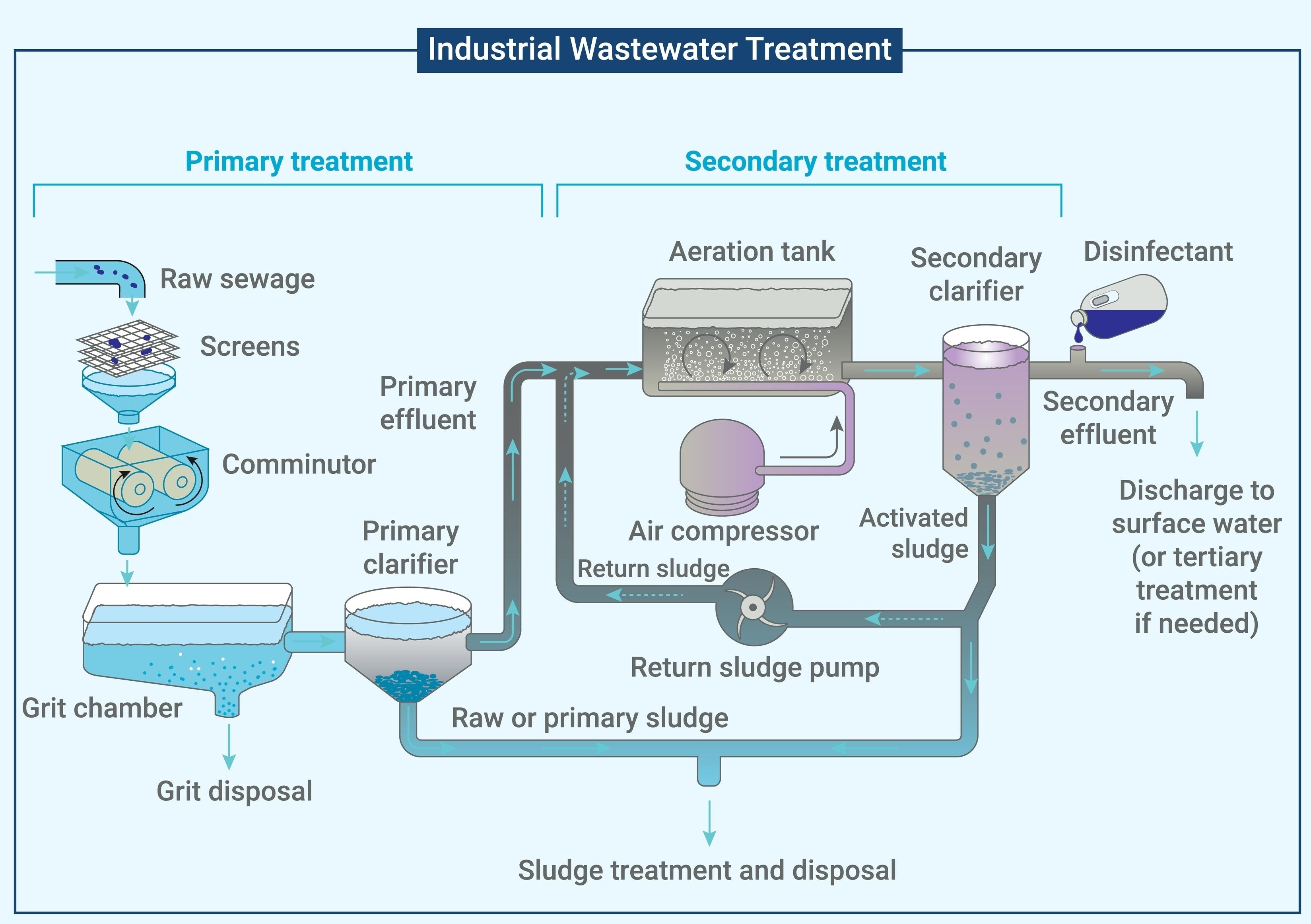
In the industrial world, water is more than just a resource—it’s a byproduct that carries the "fingerprint" of the manufacturing process. Whether it’s the heavy metals from a plating line or the complex organics from a pharmaceutical lab, industrial wastewater is notoriously stubborn. Treating it isn’t just about meeting a regulatory checkbox; it’s about engineering a sequence of transformations that turn "toxic liability" into "clear asset."
Every seasoned operator knows that a treatment plant is only as good as its Preliminary stage. This is where we handle the "physical trauma" of the incoming flow. We use mechanical screens to catch debris and grit chambers to settle out the abrasives. But the real unsung hero here is Flow Equalization. Industrial discharge is chaotic—one hour it’s acidic, the next it’s scalding hot. A massive equalization basin acts as a "buffer," blending these spikes into a steady, predictable stream that won't shock the sensitive systems downstream.
Once the large debris is out, we move into Primary Treatment, where we play with physics. This is the stage of "Coagulation and Flocculation." By adding specific polymers, we force tiny, invisible particles to stick together into "flocs."
If these flocs are heavy, we let gravity take over in a clarifier. But if we’re dealing with oils or light fibers—common in food processing or textiles—we use Dissolved Air Flotation (DAF). It’s a fascinating sight: millions of micro-bubbles act like tiny life jackets, lifting contaminants to the surface to be skimmed off. It’s elegant, efficient, and highly effective at reducing the initial pollutant load.
This is where the magic (and the science) really happens. In Secondary Treatment, we stop using chemicals and start using life. We cultivate a "living sludge"—a massive colony of bacteria that views organic waste as a buffet.
Whether we use the classic Activated Sludge method or more modern MBBR (Moving Bed Biofilm Reactor) carriers, the goal remains the same: provide enough oxygen and surface area for these microbes to thrive. When the balance is right, these microorganisms can strip away 90% of the organic pollutants. However, this stage is a delicate dance; a sudden change in pH or a toxic "slug" of chemicals can kill the bacteria, effectively "crashing" the entire plant.
In the past, we stopped at the biological stage and discharged the water. But today’s environmental landscape demands more. Tertiary Treatment is where we move from "clean enough" to "crystal clear."
This is the realm of Advanced Oxidation (AOPs), which uses high-energy reactions to snap the spines of complex synthetic molecules that bacteria can't digest. For those aiming for Zero Liquid Discharge (ZLD) or water reuse, we deploy Reverse Osmosis (RO). This pushes water through membranes so fine they can filter out individual ions. The result isn't just "treated waste"—it’s high-purity water ready to be cycled back into a cooling tower or a boiler.
Modern industrial wastewater treatment has shifted its identity. We are no longer just "treating waste"; we are running a Resource Recovery Facility. Every cubic meter of water recycled and every ton of sludge converted to biogas is a win for both the planet and the bottom line. It’s a complex, high-stakes game of chemistry and biology, but when done right, it’s one of the most vital components of a sustainable industrial future.