
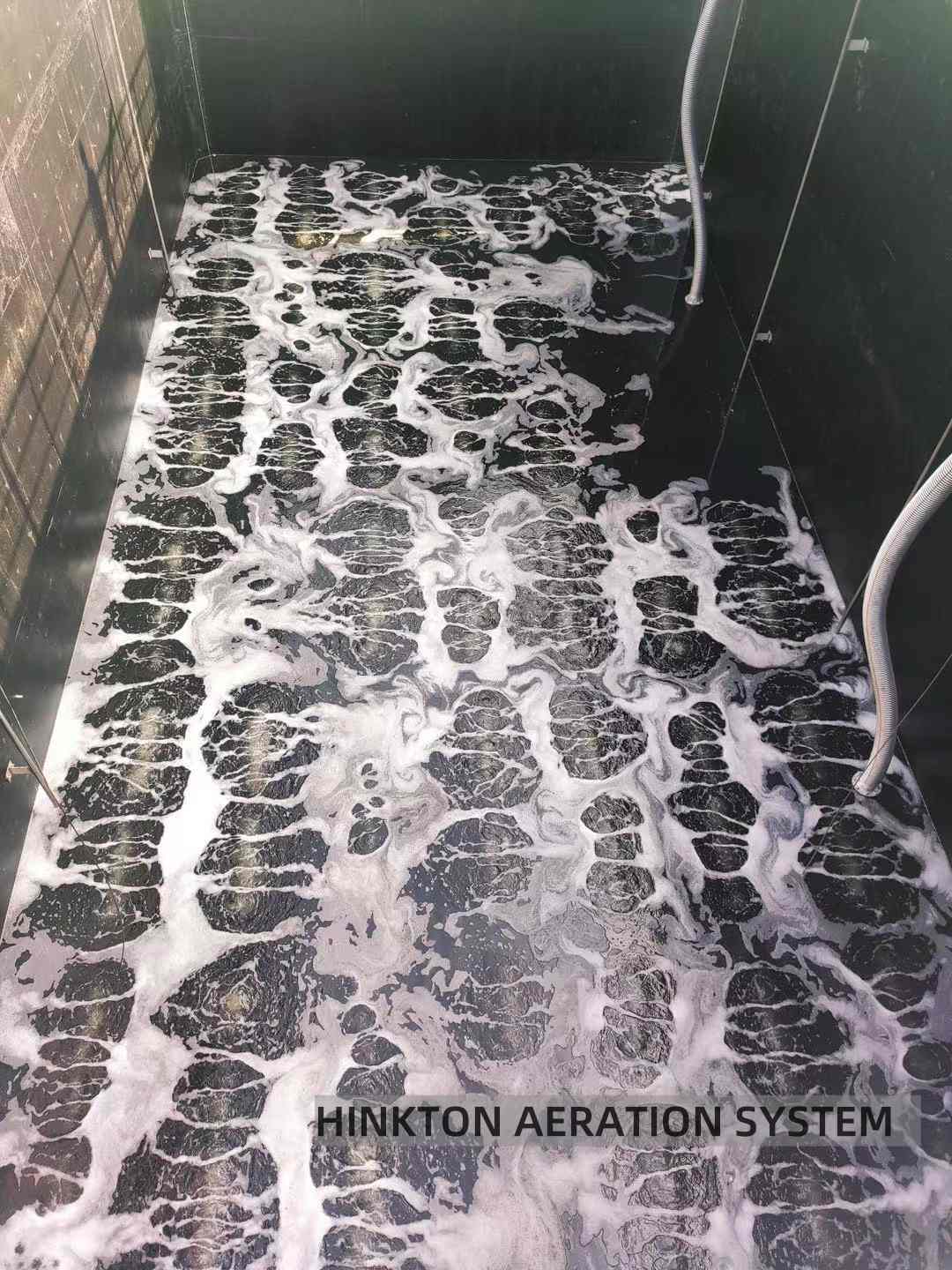
Fine bubble diffusers are one of the most efficient ways to add oxygen in this process. They create many small air bubbles that mix the water and transfer oxygen effectively.
Hinkton specializes in aeration equipment for this stage. We provide both tube (tubular) diffusers and disc diffusers, along with complete secondary treatment solutions for municipal and industrial wastewater plants.
Fine bubble diffusers release tiny air bubbles (about 0.7 – 3 mm in diameter) into the aeration tank. Because these bubbles are small, they stay in the water longer and provide more surface area for oxygen transfer. This makes them much more efficient than coarse bubble diffusers.
The main types of fine bubble diffusers include:
Tube diffusers – long perforated tubes covered with a flexible membrane.
Disc diffusers – round, flat discs with holes in a rubber or ceramic surface.
Panel or strip diffusers – used less often, but for specific designs.
Among these, tube and disc diffusers are the most common for biological aeration tanks.
Fine bubble diffusers are ideal for the secondary (biological) stage because they:
Increase oxygen transfer efficiency – smaller bubbles mean more oxygen dissolves into the water.
Reduce energy costs – more oxygen is transferred per unit of air, so blowers use less power.
Improve mixing – fine bubbles keep sludge evenly suspended and prevent dead zones.
Typical oxygen transfer efficiency can reach up to 40%, depending on tank depth and membrane quality. However, good maintenance and high-quality membranes are important to avoid fouling.
The Hinkton fine bubble tube diffuser is our core product for Stage 2 aeration. It combines efficiency, durability, and easy installation.
Main features:
Structure: A strong plastic support tube (ABS or PP) covered with a high-quality EPDM or silicone membrane with precision perforations.
Fine bubbles: Creates bubble sizes around 0.7 – 1.9 mm, ensuring excellent oxygen transfer.
Low pressure loss: Uniform air distribution reduces energy consumption.
Durable design: Membranes resist clogging, backflow, and chemical corrosion.
Flexible installation: Available in various lengths and diameters, suitable for both new plants and retrofit projects.
Hinkton tube diffusers can handle deep tanks (up to around 9 m) and continuous operation under changing load conditions. We also offer replacement membranes to help reduce maintenance costs.
Hinkton also supplies fine bubble disc diffusers, ideal for rectangular tanks or areas where round diffusers fit better.
They work on the same principle as tube diffusers, providing uniform aeration and excellent energy savings.
By offering both types, Hinkton gives engineers flexibility to design the best layout for each treatment plant.
In a typical wastewater plant, the secondary treatment stage includes processes such as activated sludge or oxidation ditches. Our diffusers play a key role in these systems by supplying oxygen and keeping biomass well mixed.
Our recommended setup:
Design & Layout: Install Hinkton tube diffusers along the tank floor in evenly spaced grids.
Aeration Control: Use variable-speed blowers to maintain dissolved oxygen levels around 2 – 3 mg/L.
Maintenance: Check membranes regularly; replace only the membrane, not the whole unit, when needed.
Performance: Expect better BOD/COD removal, stable nitrification, and reduced energy use.
Research shows that fine bubble aeration can achieve up to double the nitrogen removal rate compared to coarse bubble systems, while using less power.
Fine bubble systems are known for excellent energy performance — some designs can reach 8 kg O₂ per kWh of blower energy.
Hinkton’s durable materials and modular design reduce downtime, extend service life, and make maintenance simple.
Fine bubble diffusers are an essential part of modern wastewater treatment.
They improve oxygen transfer, save energy, and ensure stable biological performance.
Hinkton provides both tube and disc diffusers designed for the secondary stage of wastewater treatment.
Our products combine efficiency, reliability, and easy maintenance — helping treatment plants achieve clean, sustainable results at lower operating costs.


